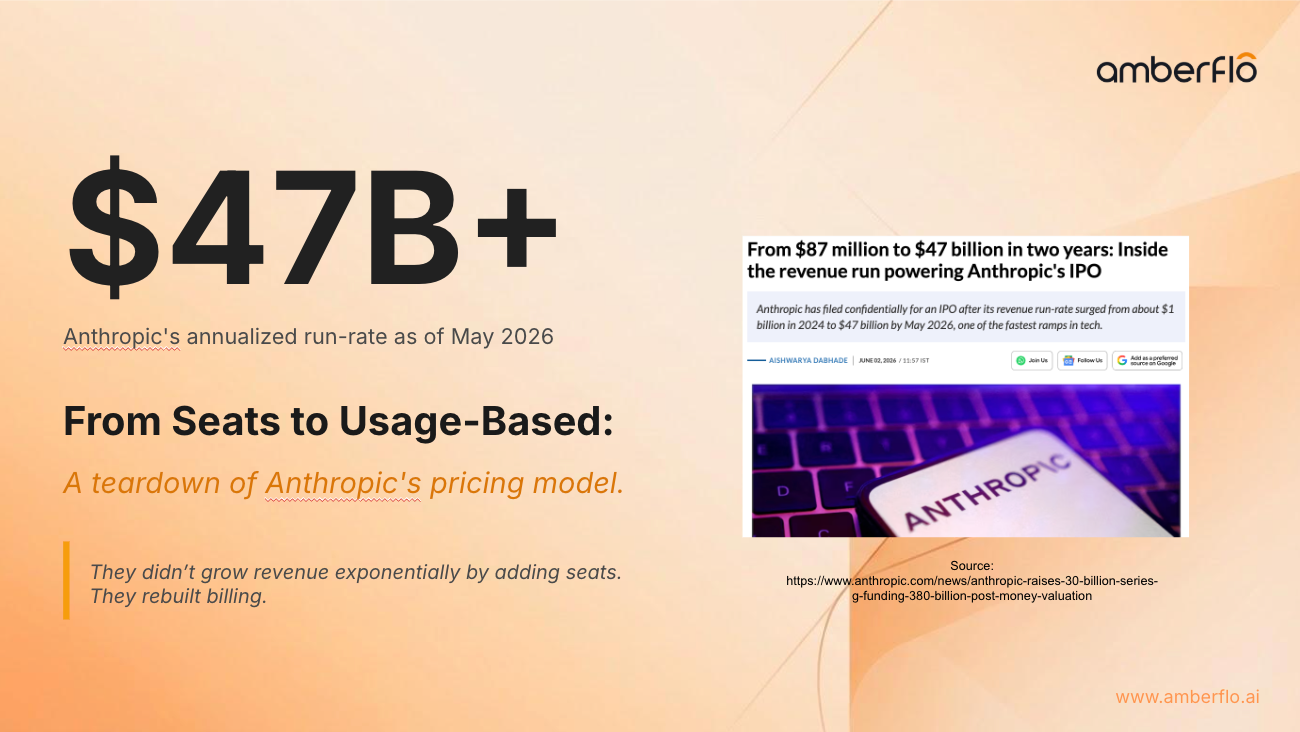
Anthropic went from $87 million to a $47 billion run-rate in about two years. It did not get there by adding seats. It changed how it charges, moving from seat-based pricing to usage-based pricing. In the latest webinar, we covered why the old seat model is breaking, how Anthropic's pricing actually works, and how Amberflo lets you build a similar pricing model yourself.
The SaaS apocalypse
The traditional SaaS business model is under attack, and industry insiders now call the moment the SaaS apocalypse. For years, the entire ecosystem ran on one thing: counting seats. Customer contracts, quoting, pricing, revenue management, and renewals all keyed off how many seats a customer bought.
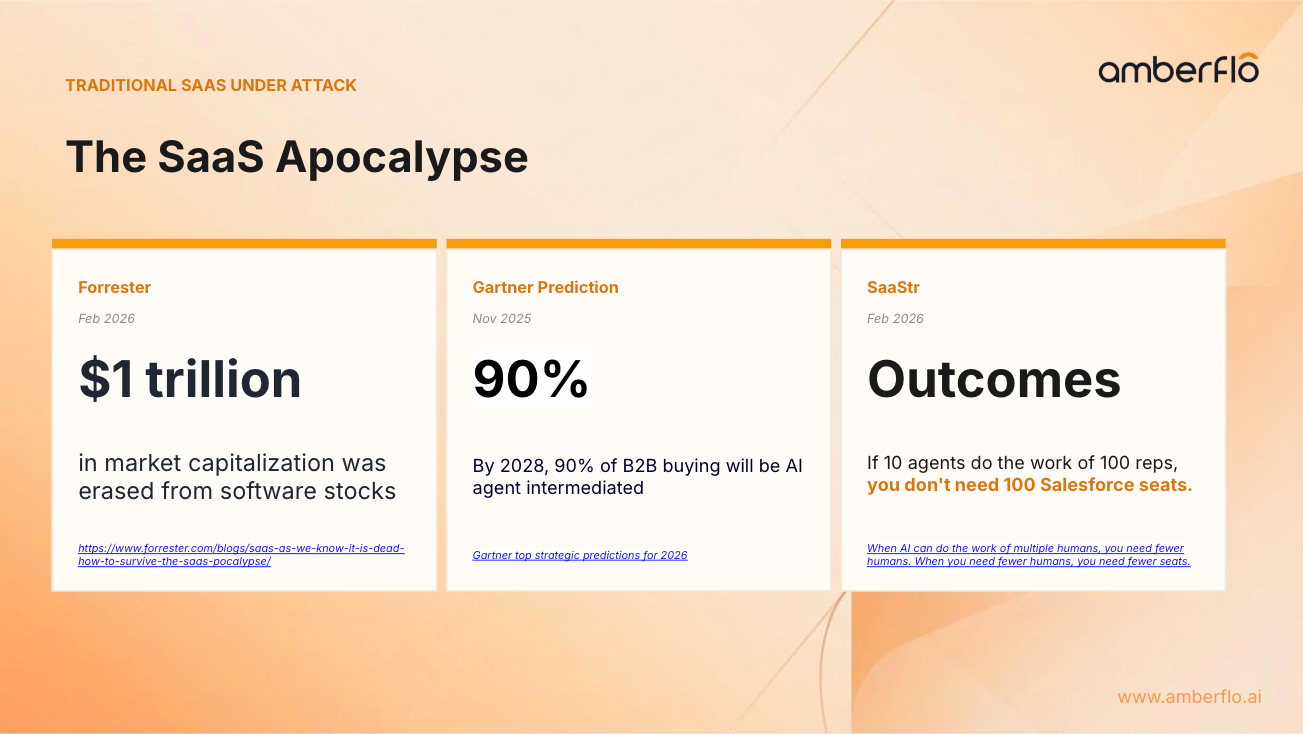
That foundation is shifting fast, because a seat count no longer measures use, usage, or outcomes. Anthropic launched with a flat, fixed seat-based model. Then, it moved to usage-based pricing. The hyperscalers showed this first. Usage-based pricing is a gift that keeps on giving. Once a company puts the foundation in place, it drives continuous, organic growth.
Teardown of Anthropic’s Pricing Model
Anthropic prices for an exceptionally large surface area. Its market spans desktop tools, direct APIs, and coding tools embedded in 3rd party platforms like VS Code. Its audience runs from individual users to teams, mid-market organizations, large enterprises, and increasingly non-human AI agents. To cover that field and drive organic network effects, Anthropic built a frictionless model on a few clear pillars.

No feature-gating: The traditional SaaS world offered several plans and locked the most powerful features behind the highest tier. Anthropic skipped that route. It makes the entire catalog of models available on any plan, so users never migrate to a new tier just to reach the latest model.
Frictionless scaling: In the old world, unlocking new features or higher limits caused friction and forced a manual change-management process or a call to sales. In Anthropic's model, users scale usage fluidly inside their current plan, without the roadblocks.
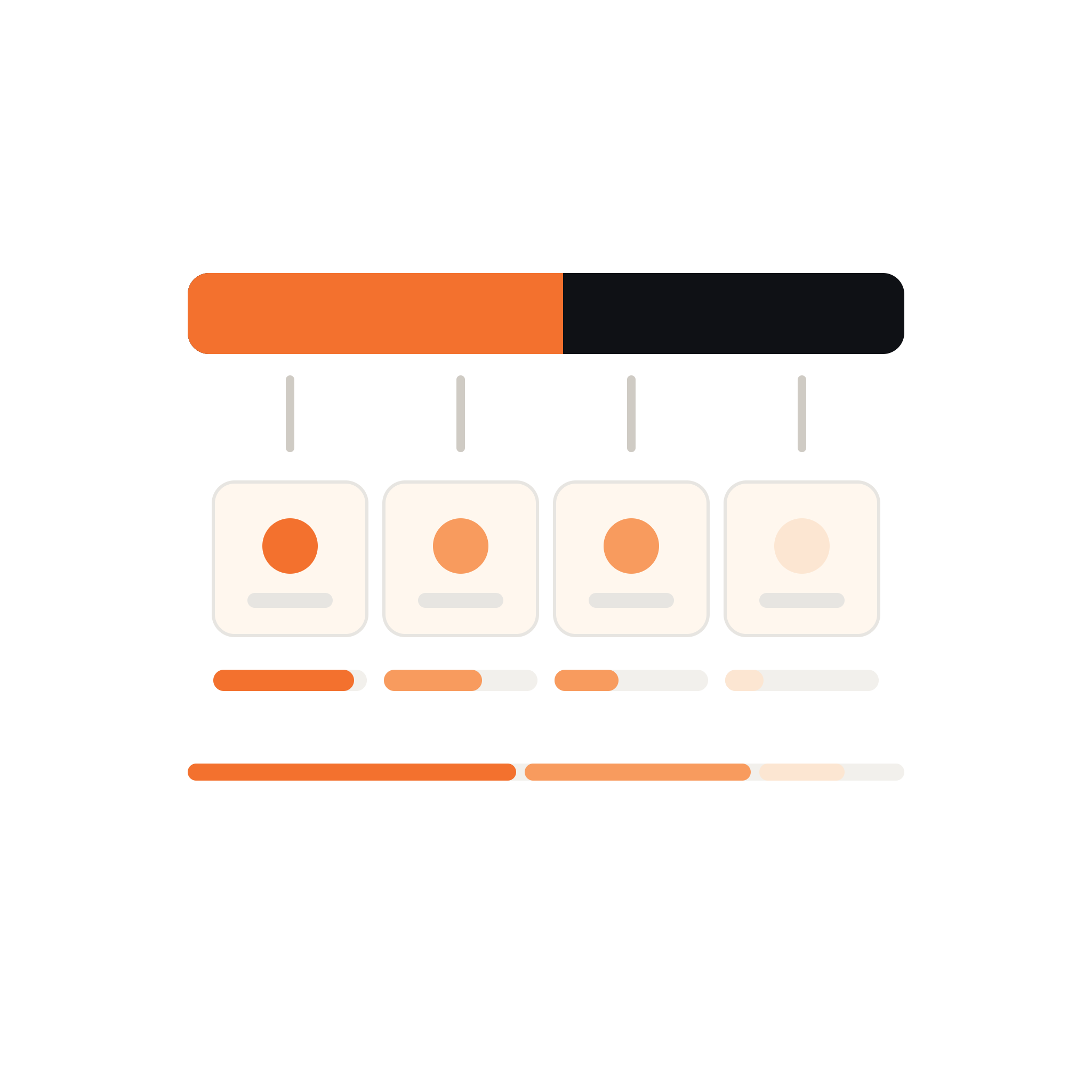
Two core vectors: Behind the scenes, the whole strategy rests on two vectors: a fixed recurring charge and a usage-based component. Anthropic combines those two in different variations to cover its entire market, and the same canvas keeps scaling as it launches new products.

Enterprise viability: Enterprises need fixed budgets and forecasting, which usage-based pricing can complicate. Anthropic answers with prepaid credits, true-ups, and drawdown mechanisms. Large organizations buy a pool of credits up front while the platform tracks and attributes every metered unit underneath.
What It Takes to Run This Model
A model like this needs a modern AI monetization engine. The traditional approach stitched together a CRM, a CPQ tool to assign plans, and a third-party invoicing system. That web of integrations stayed complex and resisted automation.

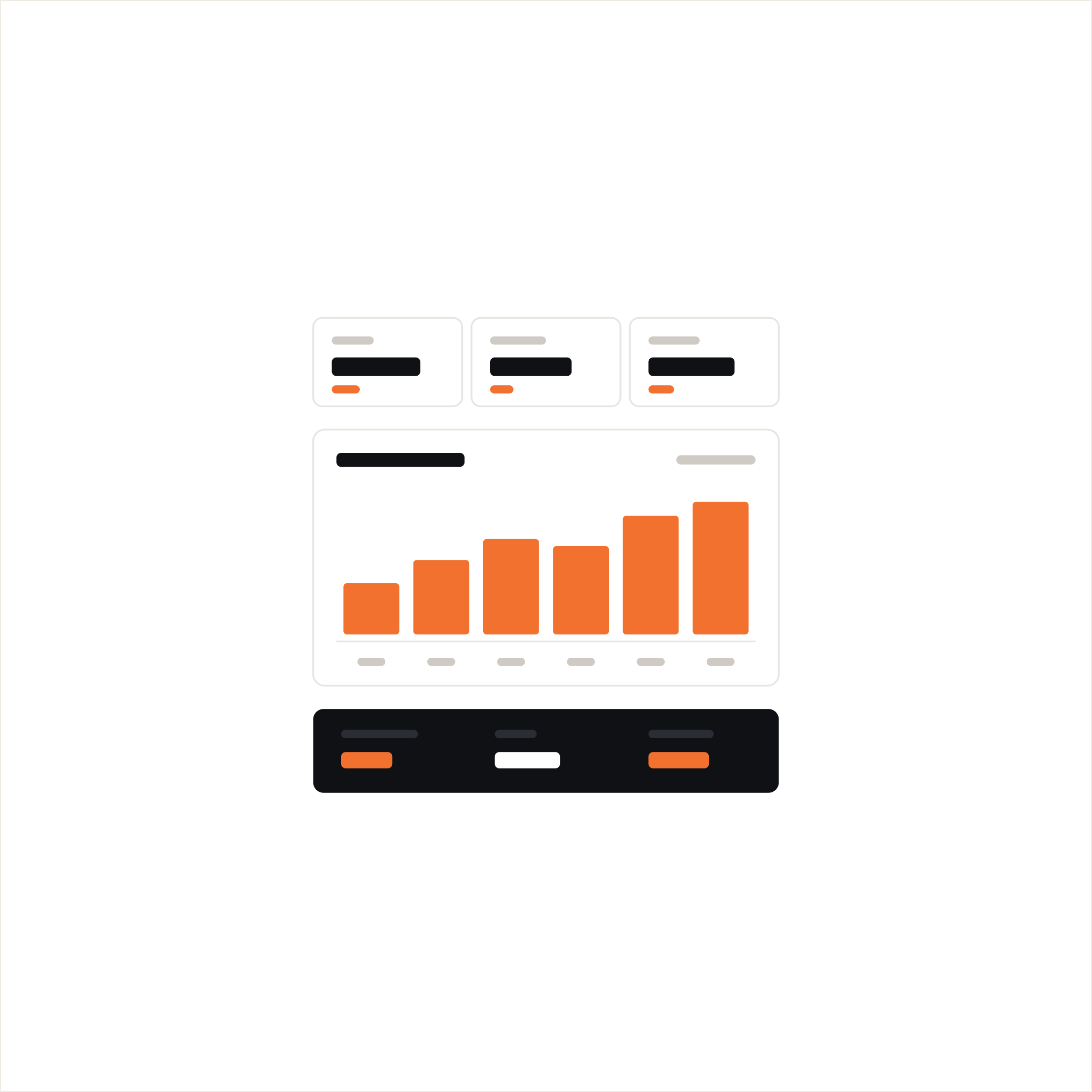
A modern engine replaces with a single system of record that runs the whole workflow, from designing the pricing plan to delivering the final invoice. Its core building blocks include metering, real-time aggregation, cost tracking, billing, credits, drawdowns, alerting, and cost guards. The platform meters, attributes, and rates every customer interaction and every API call.
The engine also has to track internal cost at the customer level. Say a customer pays you $1,400 in a month, and the AI usage to serve them costs you $153. That leaves about $1,247 in profit. You only know that if you track both numbers, what the customer pays and what they cost you. Look at just one, and you can seem profitable while quietly losing money on your heaviest users. Only by holding internal cost and customer billing side by side can a team build pricing that profits the business and that customers accept.
How Amberflo helps you build Anthropic-style pricing
Amberflo's AI Monetization Platform measures usage, applies your pricing, and sends accurate bills. It lets you pick a pricing model and launch it, instead of stitching together billing software for months.
With Amberflo you can run any of the common models:
A flat fee with usage included (the Anthropic Max style): The customer pays a set monthly price and gets a set amount of usage. If they hit the limit, you slow them down rather than charge more. Predictable for the customer, simple for you.
A flat fee for access, then pay for what you use: The monthly fee just unlocks the product. Everything the customer actually uses gets billed on top, line by line, so the invoice is clear.
A flat fee with an allowance, then pay-as-you-go: The monthly fee includes a set allowance. Once the customer passes it, the extra usage is billed automatically. You get steady revenue, and the customer avoids surprise bills. This is the most common model today.
Prepay a budget and draw it down: The customer pays up front, say $500 or $1,000, and their usage spends down that balance. Amberflo warns them at 80 and 90%, and can top the balance back up automatically.
One thing sits underneath: Amberflo measures each unit of usage once, then uses that number two ways: to bill the customer, and to show what that customer costs you to serve. Put those two numbers side by side, and you finally know which customers make you money and which ones quietly lose it.
The seat is no longer the unit of value. Anthropic showed that a simple set of plans can sit on top of a flexible, usage-based engine, and that the same usage data can run both your billing and your margins. None of this is new or secret. The model is in plain view, and the tools to build it already exist. The only question is who moves first.

.svg)

.svg)

.svg)
.svg)